Our Products
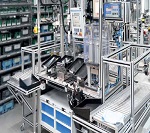
- Assembly lines
An assembly line is a sequential production process in which prefabricated parts are joined to create a finished product, moving through consecutive workstations. It uses conveyor belts to move the product, allowing each operator or robot to perform a specific and repetitive task, increasing speed and reducing time and costs.
Key Aspects of an Assembly Line:
- • Logical Sequence: Operations follow a strict order (design for assembly), where the product moves from one station to another.
- • Specialization: Each worker or robot performs a simple and specific task, minimizing movement and maximizing efficiency.
- • Automated Transport: Conveyor belts are typically used to move parts between stations.
- • Line Balancing: Tasks are balanced so that each station takes the same amount of time, optimizing production.
- • Automation: Many modern lines include robots for heavy or repetitive tasks. Benefits:
- 1. High Efficiency: Drastically increases the speed of mass production.
- 2. Cost Reduction: Decreases labor time per product.
- 3. Consistent Quality: By repeating the same task, the assembly quality is more uniform.
This system is fundamental in the manufacture of automobiles, household appliances, and in the electronics industry.